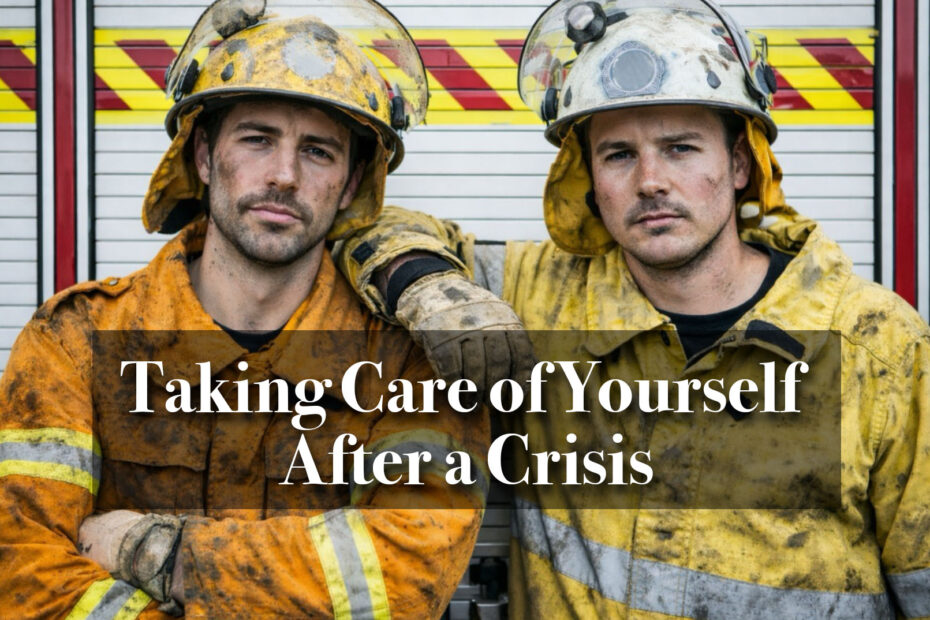
When crisis strikes — whether within a family, a local community, or across national boundaries breached by hostility — men are almost always among the first to step forward. More often than not, they will set aside concern for their own safety in order to fulfil an instinctive protective responsibility.
When it is called for, men suppress fear and distance themselves from the emotional content of their own experience so that they can remain clear-headed, task-focused, and undistracted in defending against threat and restoring stability where there is chaos.¹
Quite contrary to contemporary disdain for masculine strength, the capacity to remain steady under pressure — even when not overtly “in touch with one’s emotions” — is an indispensable asset to human survival. Research on disaster and trauma response consistently indicates that men, despite equal or greater exposure to dangerous and life-threatening circumstances, often report lower rates of post-traumatic difficulties than women.² ³
Some men do, of course, run into difficulty. Strictly regulating emotions and thoughts that might impede one’s capacity to respond during crisis — putting them on hold until danger has passed — can lead to later psychological difficulties. Problems that may emerge include:
• Persisting emotional suppression. Shutting out emotions long after doing so is adaptive can restrict emotional range and relational connection. A conscious effort may be needed to reconnect with feelings that were temporarily suspended, allowing them to be reflected upon and fully experienced.¹ ⁴
• Restlessness and inability to relax. Many men disperse emotion through activity. Physical action can be healthy and regulating. Yet compulsive or relentless activity may function as avoidance when feelings are “calling out for attention.”¹
• Social withdrawal. Retreating from usual friendships and social contact is often an early sign of emerging mood disturbance or anxiety. Maintaining contact, confiding in trusted friends, and remaining socially engaged are protective factors in men’s psychological wellbeing.⁵
• Increased alcohol use. Using alcohol to dampen residual stress may provide short-term relief but ultimately may give rise to anxiety, mood instability, and sleep disturbance.⁶
If, after a crisis, these patterns prove difficult to shift — particularly if accompanied by prolonged stress, irritability, anger, anxiety, low mood, or fatigue — it is time to seek professional support from a psychotherapist, psychologist, or an appropriately trained pastoral professional.
As men, we are often remarkably resilient in the face of crisis. But resilience does not mean limitlessness. We owe it to ourselves, and to those who depend upon us, to seek assistance well before we are overwhelmed.
References
¹ Ashfield, J. A. (2011). Doing psychotherapy with men: Practising ethical psychotherapy and counselling with men. Australian Institute of Male Health and Studies.
² Bonanno, G. A., Galea, S., Bucciarelli, A., & Vlahov, D. (2007). What predicts psychological resilience after disaster? The role of demographics, resources, and life stress. Journal of Consulting and Clinical Psychology, 75(5), 671–682.
³ Olff, M., Langeland, W., Draijer, N., & Gersons, B. P. R. (2007). Gender differences in posttraumatic stress disorder. Psychological Bulletin, 133(2), 183–204.
⁴ Addis, M. E., & Mahalik, J. R. (2003). Men, masculinity, and the contexts of help seeking. American Psychologist, 58(1), 5–14.
⁵ Courtenay, W. H. (2000). Constructions of masculinity and their influence on men’s well-being: A theory of gender and health. Social Science & Medicine, 50(10), 1385–1401.
⁶ Boden, J. M., & Fergusson, D. M. (2011). Alcohol and depression. Addiction, 106(5), 906–914.