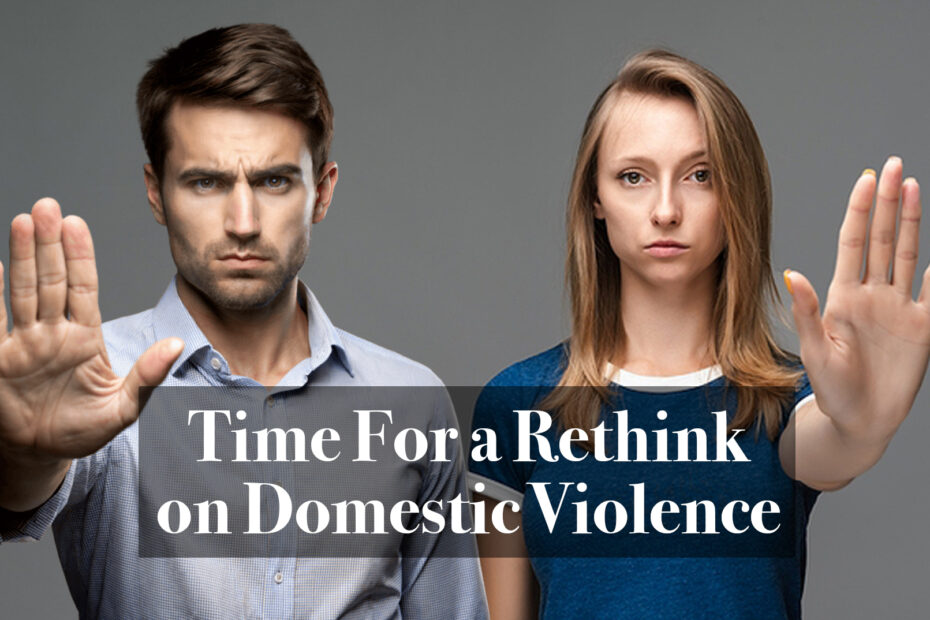
Relationship violence (whatever form it takes) is an undeniable sign that a relationship has run into serious trouble. It also indicates the very likely risk of further violence becoming a pattern – as well as the end of the relationship.
Until recently we thought the problem was simply a matter of some men being violent towards their partners – which is what social activists, television and other media campaigns have largely concentrated on. If only it was that simple.
In the past, to have suggested that women perpetrate and engage in relationship violence has been mostly dismissed, with the argument that such instances are so few that they are irrelevant to the overall picture, or that women only use violence in self-defence. It turns out that this is not the full picture.
We now know that violence can go both ways, and that in a significant proportion of cases it emerges within the dynamics of the relationship rather than from one side alone.³
Clearly, this is a bigger problem than even media publicity has sought to portray because it’s a problem for men and for women. It’s a wider human problem, and one that has no simple gender boundaries.
At the same time, the best available evidence indicates that women are still more likely overall to experience serious and injurious forms of partner violence, and are disproportionately represented in outcomes such as sexual assault within relationships, hospitalisation, and domestic homicide.¹ ²
Fortunately, only a minority of women and men use violence in their relationships. And it is dishonest and misleading to suggest otherwise – about either gender.
Nevertheless, all of us need to say “no” to relationship violence; all of us need to do our best to put a stop to it. It is a problem we must own as a community.
There are no simple solutions – especially since we know that higher rates of violence occur in situations in which women and men are under financial pressure, misusing alcohol, or other substances, or are unemployed. To make matters more complicated, we also know that violence often runs in couples, with both partners involved in a significant proportion of cases.³
Understandably, people currently employed to tackle the issue of relationship violence will feel very anxious about how to come to grips with this more complex reality. But their greater concern should be that if they don’t take into account the full facts, they will simply ensure that it is never properly understood or remedied – which will benefit neither women nor men who experience such violence.
Yes, we need to say a resounding “no to violence against women”. But we must now also say “no to violence against men”, and overhaul our thinking, our literature, and our slogans in relation to this issue.
This includes recognising that coercive and controlling behaviour is not confined to men. While more severe, fear-based and physically injurious patterns are more often associated with male perpetrators, other forms of control—such as manipulation, shaming, persistent criticism, and the erosion of self-esteem—are frequently reported by men as coming from female partners, and remain less visible and less well captured in current research.⁴ A failure to acknowledge this risks overlooking a significant number of victims.
Where necessary, legal, health, and welfare services must admit they’ve been poorly informed, and revise their internal cultures, their attitudes, and their programs and practices in relation to this issue. Men and women must be protected from domestic violence.
There is no longer any excuse for denial or oversimplification on this subject. The evidence is too substantial, and the effects of relationship violence on men and women are too damaging, for us to allow partial accounts to prevail.
References
- Office for National Statistics. (2025). Domestic abuse in England and Wales overview: Year ending March 2025. https://www.ons.gov.uk/
- Australian Institute of Health and Welfare. (2024). Family, domestic and sexual violence: Intimate partner violence and health outcomes. https://www.aihw.gov.au/
- Australian Bureau of Statistics. (2021). Personal Safety Survey. https://www.abs.gov.au/
- Office for National Statistics. (2023). Partner abuse in detail, England and Wales (year ending March 2023) — includes breakdowns of non-physical abuse, controlling behaviours, and reporting differences between men and women. https://www.ons.gov.uk/