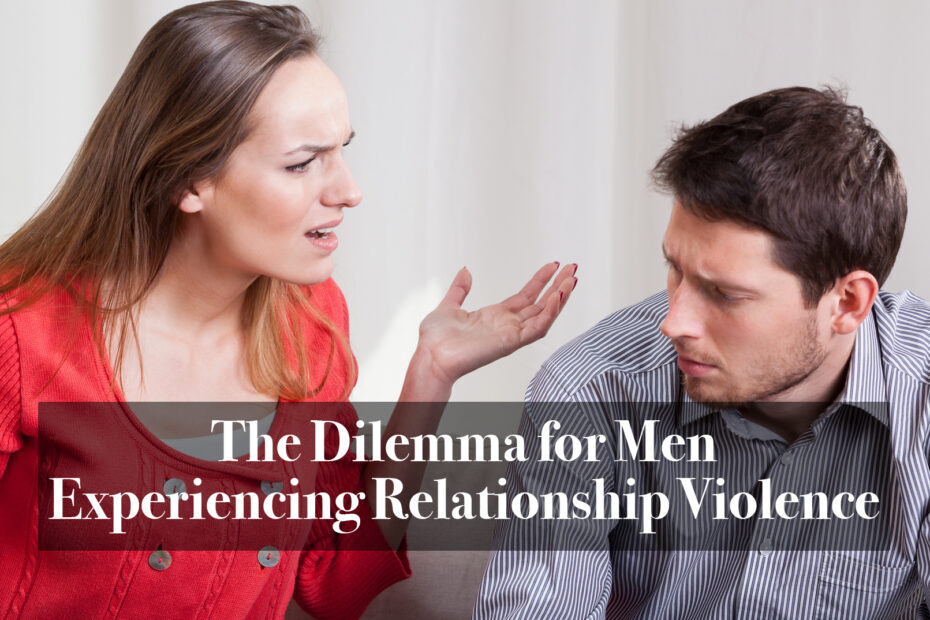
A reality that can no longer be ignored is just how many men experience violence in relationships, from their female partners. Studies worldwide now clearly indicate that relationship violence isn’t the one-way thing that has been previously assumed 1,2. We now know that a significant number of women also perpetrate relationship violence 1,3. But not only is it difficult to get men to take action and report their experience of domestic violence, it’s an uphill battle to get them taken seriously 4,5.
Men are generally reluctant to admit they’ve been assaulted or abused by a female partner, because of the indignity of appearing weak, and because it reflects poorly on their identity as men 4,6. Some men would rather put up with violence and abuse, because they don’t believe it’s right to defend themselves against women 6.
Men who do report violence or abuse by female partners are often disbelieved – simply because they are men 4,5. The simplistic idea that there are only perpetrators and victims, and that only men are perpetrators, is still entrenched in many health and welfare services – which consequently fail to take men seriously, minimise their experience, or treat it as something of a joke 5,7. But there is nothing humorous about domestic violence for men or for women. It is degrading and unacceptable and may be dangerous and criminal.
Domestic violence is often a clear indication that a relationship is in dire straits and, without immediate and appropriate assistance, will likely end, with potentially damaging consequences for both partners 8.
It is important to note that despite the shame and indignity men often experience when admitting to being abused, evidence indicates that when services are set up to genuinely and respectfully listen to and support men, such services are in great demand 4,9.
Domestic violence may also take other forms like: emotional and verbal violence (involving things like humiliation, betrayal, verbal assault, and manipulation); financial violence (knowingly exploiting and taking advantage of a partner financially); sexual violence (like being intentionally dishonest about contraception, or humiliating a partner sexually) 10. Whatever form it takes, such violence is unacceptable. Men experiencing it need to seek assistance – even if only from a friend, to work out options and to take action. Men will sometimes need to be supported to make the decision to leave a violent relationship – at least temporarily, and, if children are also at risk, to report the situation to relevant authorities.
Getting help is no simple matter for men. Not many helping agencies are equipped to either understand or deal effectively with men’s experience and issues 5,7. But this situation will only change when men assert their right to respectful, professional, and gender sensitive services, with personnel who have an appropriate attitude, and appropriate knowledge and training to work with men. Poor and unresponsive services usually remain that way, only for want of consumers willing to thoughtfully and confidently complain.
References
1. Archer, J. (2000). Sex differences in aggression between heterosexual partners: A meta-analytic review. Psychological Bulletin, 126(5), 651–680.
2. Straus, M. A. (2011). Gender symmetry and mutuality in perpetration of clinical-level partner violence: Empirical evidence and implications for prevention and treatment. Aggression and Violent Behavior, 16(4), 279–288.
3. Desmarais, S. L., Reeves, K. A., Nicholls, T. L., Telford, R. P., & Fiebert, M. S. (2012). Prevalence of physical violence in intimate relationships, Part 1: Rates of male and female victimization. Partner Abuse, 3(2), 140–169.
4. Tsui, V. (2014). Male victims of intimate partner abuse: Use and helpfulness of services. Social Work, 59(2), 121–130.
5. Hines, D. A., & Douglas, E. M. (2010). Intimate terrorism by women toward men: Does it exist? Journal of Aggression, Conflict and Peace Research, 2(3), 36–56.
6. Migliaccio, T. A. (2002). Abused husbands: A narrative analysis. Journal of Family Issues, 23(1), 26–52.
7. Bates, E. A. (2020). “Walking on eggshells”: A qualitative examination of men’s experiences of intimate partner violence. Men and Masculinities, 23(2), 389–409.
8. Capaldi, D. M., Knoble, N. B., Shortt, J. W., & Kim, H. K. (2012). A systematic review of risk factors for intimate partner violence. Partner Abuse, 3(2), 231–280.
9. Douglas, E. M., & Hines, D. A. (2011). The help-seeking experiences of men who sustain intimate partner violence. Journal of Family Violence, 26(6), 473–485.
10. World Health Organization. (2012). Understanding and addressing violence against women: Intimate partner violence. WHO Press.